Max Friedman didn't set out to build one of the most widely used fundraising platforms in the nonprofit sector. He and his two co-founders, Ari Krasner and Liran Cohen, started with a simpler observation: the tools available for people who wanted to raise money for a cause were either expensive, hard to use, or both. And the fees were rarely transparent.
That was 10 years ago. Today, Givebutter has processed nearly $10 billion in donations, acquired nonprofit media brand We Are For Good, launched financial products for nonprofits, and is pushing past 150 employees with plans to hit 200 by end of year.
Friedman joined the Disruptors for Good podcast to talk about the journey, the hard stretches, and what the next decade looks like for Givebutter and the broader nonprofit tech space.
Starting in a Dorm Room, Staying Bootstrapped for Three Years
The founding story is straightforward. Three college students, all involved in volunteering and fundraising, noticed that the tools available to them were either clunky or out of reach for most organizations. They built something better.
"It wasn't much more than that," Friedman said. "Some tools are better but expensive and you have to talk to a salesperson. Some are easier to use but don't have the functionality. And fees were not always transparent."
Givebutter launched with a campus ambassador program and a clear focus on young donors and student-run fundraising. The early adopters were their peers. Some of them now work at Givebutter. Others went on to start or work at nonprofits who became customers.
The company bootstrapped for roughly three and a half years. Not by choice, but by circumstance. They pitched Y Combinator and didn't get in.
They pitched investors and got rejected, by Friedman's estimate, around a hundred times. They lived and worked out of a studio apartment with bunk beds, stocked a Costco pantry, and kept building.
"Greatness to me is goodness over time," Friedman said. "You do a little bit of good every day and one day you look in the rearview mirror and you may be very surprised by the results."
By the time they graduated, the company was generating somewhere between $15,000 and $30,000 in revenue. Enough for a studio apartment. Not much more.
The Pivot That Almost Wasn't: Events, COVID, and Survival
The first major product expansion came when nonprofits started using Givebutter's donation forms as makeshift ticketing tools.
Friedman and his co-founder flew to Atlanta to see one of their biggest nonprofit customers, Brawl for a Cause, use the platform at the Mercedes-Benz stadium.
The organization raised around $350,000 through the platform that night. It was early validation that events were the next phase.
Then COVID hit.
"The two weeks when the travel ban was announced, I really thought we're not going to last through this," Friedman said. "I genuinely thought this might be the end of Givebutter."
Donations froze. The in-person event use case evaporated.
But something unexpected happened.
Demand for PPE fundraising exploded.
Local newspapers that could no longer sell advertising turned to their subscriber bases for donations, and Givebutter suddenly appeared on hundreds of local news sites.
The company didn't just survive COVID. It grew faster during 2020 than in any of the three or four years before it.
That period forced a product pivot toward virtual events and auctions. When in-person events returned, Givebutter had built the infrastructure to support them properly.
From $200K Angel Round to $50M Growth Equity
The fundraising journey mirrors the product journey: slow, then not.
Givebutter raised a small angel round in 2019, targeting $500,000 and closing on $200,000. Friedman describes it as a blessing in disguise. They hired their first two employees with that capital.
The next year, 2020, the company was profitable. In the years that followed, they raised a $7 million seed round and then a $50 million growth equity round, all on the back of a profitable, fast-growing business.
By the time investors were competing to get in, Givebutter could be selective. They prioritized mission-aligned investors who had bootstrapped their own businesses and wanted to build sustainably rather than chase growth at all costs.
"Ironically, we had the luxury of being very choosy," Friedman said, "by virtue of all the rejections we received along the way."
The Business Model: Aligned Incentives, Transparent Fees
Givebutter's core revenue model is built around tips, platform fees, and payment processing. When nonprofits raise more, Givebutter earns more. Friedman has always positioned this as the key differentiator: the incentives are fully aligned with the organizations using the platform.
That model has since been adopted by others in the space, which Friedman reads as confirmation rather than a threat. "That is a sign that the market is converging on a model that resonates with people."
The company's most recent product expansion is a financial layer called Wallet, which offers nonprofits 2.5 percent APY rewards on their balances.
Card issuing is next.
The pitch to nonprofits is simple: don't just raise more, earn more on what you've already raised. Friedman wants to shift the sector's orientation from cost-cutting to capability-building. "I want to shift the narrative from saving money to having a greater impact."
The We Are For Good Acquisition
Earlier this year, Givebutter acquired We Are For Good, the nonprofit media and community platform co-founded by Jon McCoy, Becky McCoy, and Julie Confer.
The two organizations had been in each other's orbits for four or five years before the deal came together.
Friedman pointed to HubSpot's acquisition of The Hustle as a model for what media and technology can accomplish together. The parallel is apt: a platform with scale and infrastructure, combined with a trusted editorial brand and an engaged community.
We Are For Good retains full editorial autonomy.
Givebutter's role is to extend its reach, fund local meetups, and power virtual summits. The most recent We Are For Good Summit drew thousands of virtual attendees and hundreds of in-person participants at local events, including a New York meetup with over 100 people.
"We're better together," Friedman said. "Every change maker should have access to community, mentors, and peers."
What Givebutter Actually Thinks About AI
Friedman is bullish on AI for the nonprofit sector, and he's specific about why.
Givebutter shipped 85 product updates in January alone, more than double the output compared to the same period a year prior. A significant portion of that speed comes from AI-assisted engineering and internal tooling.
But the case he makes for nonprofits isn't about efficiency in the abstract. It's about capacity. Most nonprofit teams are under-resourced. They're asked to do more with fewer people and smaller budgets than their for-profit counterparts. AI doesn't replace that need. It addresses it.
"There's not a shortage of work to be done," Friedman said. "Capacity has always been the bottleneck."
Early internal surveying at Givebutter found that a significant share of nonprofit professionals are already using AI tools for research and writing, but most don't feel they're using it effectively.
The bigger opportunity, in Friedman's view, is in CRM and data. Taking the information nonprofits already have and turning it into action.
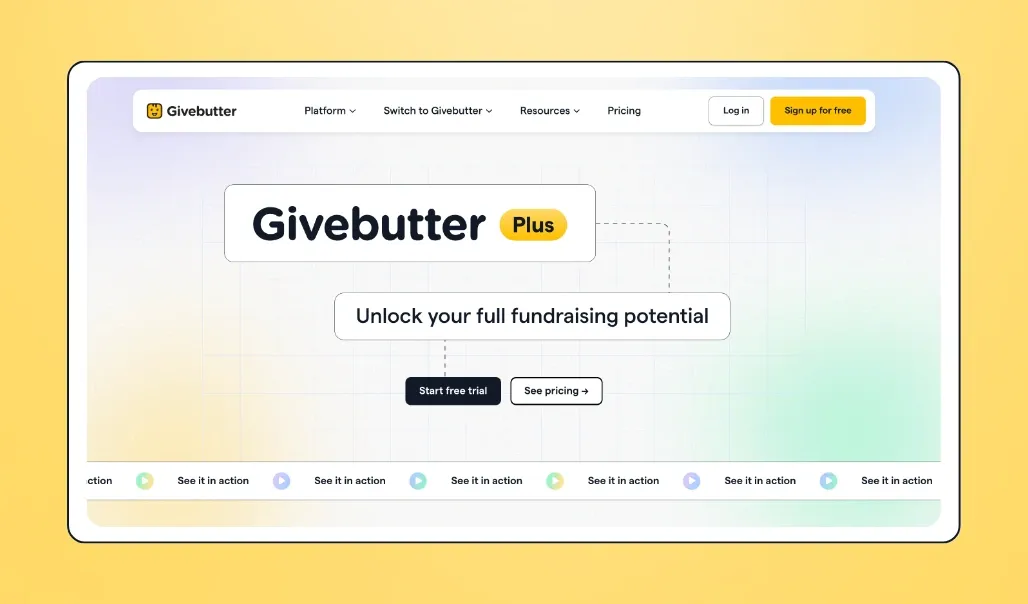
That's what he's building toward with Givebutter's next product phase, which will be unveiled at the company's annual event called The Spread, planned for September.
On Competition and Trust
Givebutter is no longer a scrappy challenger. It has a target on its back, and Friedman is comfortable with that.
What he's less comfortable with is what he sees as an emerging trust problem in nonprofit tech. One company in the space, which he didn't name but described as publicly disclosed, was found holding $29 million in customer funds that became frozen and potentially missing. Nonprofits reported waiting 30, 60, even 90 days to access their own money.
"The last thing nonprofits need to worry about is the technology they're using and what's happening under the hood," Friedman said.
Givebutter's response has been transparency as a competitive advantage. Same-day fund access, published fee structures, and a business model that only works when their customers succeed.
The Next 10 Years
Givebutter is at 150 employees and hiring toward 200 by the end of 2026. Friedman is accelerating headcount, not pulling back, because he sees more opportunity than at any point in the company's history.
The themes he's focused on for the next decade: AI-native product development, financial tools that help nonprofits grow their resources rather than just move them, and community infrastructure that makes the sector less isolated and better connected.
"We are still just getting started," he said. "Especially with the opportunity that AI creates, not just for our ability to ship product faster, but to deliver innovation for our customers."